
The Desert Dance of Predator and Prey
I'm sure it had been raining hard all night in Idyllwild, but above our campsite ten miles outside of Borrego Springs, the storm merely generated a luminescent veil of creamy gray-tones that chased a piercing winter solstice moon. Ten rain drops were enough to compel me to put the rain fly on the tent during the middle of the night, but the morning sunrise, and waves of gently warming air, meant we could wear shorts and tank tops while most of southern California put up with wind, rain, mud slides and traffic jams. It seemed as if the desert canyons beckoned us to visit until we readied our fanny-packs, watched looming rain clouds engulf the higher distant peaks, and then set out for a morning hike to discover whatever Mother Nature deemed willing to show. Today that lesson would be one of Earth's most ancient stories, the struggle for life and the inevitability of death.
Anza Borrego Desert State Park will always be one of my favorite wilderness areas. Encompassing nearly a million acres of wild lands, we can thank the vision of wilderness preservationists like Harry James for recognizing that people need a place of such expansiveness and wildness to temporarily release us from the shackles of civilization and refresh our souls with a deep cleansing breath of nature. As a naturalist, I'm in a sense no different, I crave wild places after spending too much time looking at the same trees outside my office window, or after the fourth trip down to Hemet in the same week begins to lose its fascination!
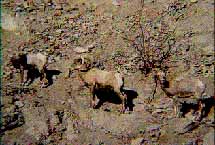
The canyon we choose to hike was called Bitter Creek Canyon, and my curiosity about the name only added to the need to explore a new environment. Like so many desert washes, this canyon bore evidence of extremes—in flooding, drought, heat, and cold. The wash was home to numerous resident and migrant birds and mammals. The black-crested Phainopepla boldly defended its feeding territory of mistletoe infested Creosote bushes, munching on the toxic fruit and flaunting his natural immunity, while unknowingly spreading sticky seeds through his feces, and thereby extending the range of the tenacious plant parasite. The first flowers of the rainy season were from the Chuparosa, a perennial shrub whose dense red inflorescence and ample nectar provide a winter-long food supply for the Anna's Hummingbird. While a pair of Rough-legged Hawks soared above our heads, the tracks of Black-tailed Jack Rabbit, Merriam's Kangaroo Rat, Coyote, and Mule Deer crisscross the sandy wash suggesting they were participants in an all-night dance marathon.
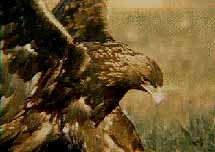
Further up the canyon, I caught a glimpse of movement while pondering the presence of a lone Cottonwood tree growing high upon the wall of the north-facing slope. Training binoculars on the point of movement, my "gestalt" reflex told me "Golden Eagle," yet it wasn't until about five minutes later that the huge bird launched herself from a hiding place and proved my hunch. The eagle flew low and slow down canyon over our heads as she caught a warm updraft, tipping her wings into the thermal air bubble and began an ascent that rapidly lifted the magnificent bird to an altitude of several hundred feet.
Curiosity over the eagle brought us to the base of the slope where we noticed peculiar vertical lines extending many feet from the lone tree to near the spot where the eagle had lifted off. The lines turned out to be a series of metal and plastic pipes supplying a steadily dripping source of water to an old claw foot bathtub. This "wildlife guzzler" was a tool to enhance the survival of wildlife by providing water at times when the desert can literally be as dry as a bone. Even the best desert-adapted animal needs water, whether it comes from a natural spring or juicy vegetation, to survive. Range managers built these low-tech water systems decades ago to keep cattle alive, but the real beneficiaries have been the Mule Deer and Bighorn Sheep and Golden Eagles, and the hundreds of other species whose survival is measured in the day to day struggle to find food, water and shelter.
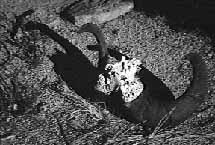
We soon noticed large numbers of sun-bleached bones scattered around the guzzler and even more near the Cottonwood tree and willows that grew densely around the spring. Finding intact skeletons of Mule Deer and Bighorn Sheep, and smaller bones from many other species, set off my intuitive "red light" as I realized we had just walked right into the dining room of a Mountain Lion! I checked the black mud surrounding the spring for sign of fresh lion tracks but was only mildly relieved to find nothing recent. The desert drama that had played out around us was exciting enough to imagine without coming face to face with the big kitty that called this place home. Walking back to camp, my mind and spirit recharged by the heady emotions gleaned from this timeless desert dance of survival between predator and prey, I felt an overwhelming sense of wilderness.